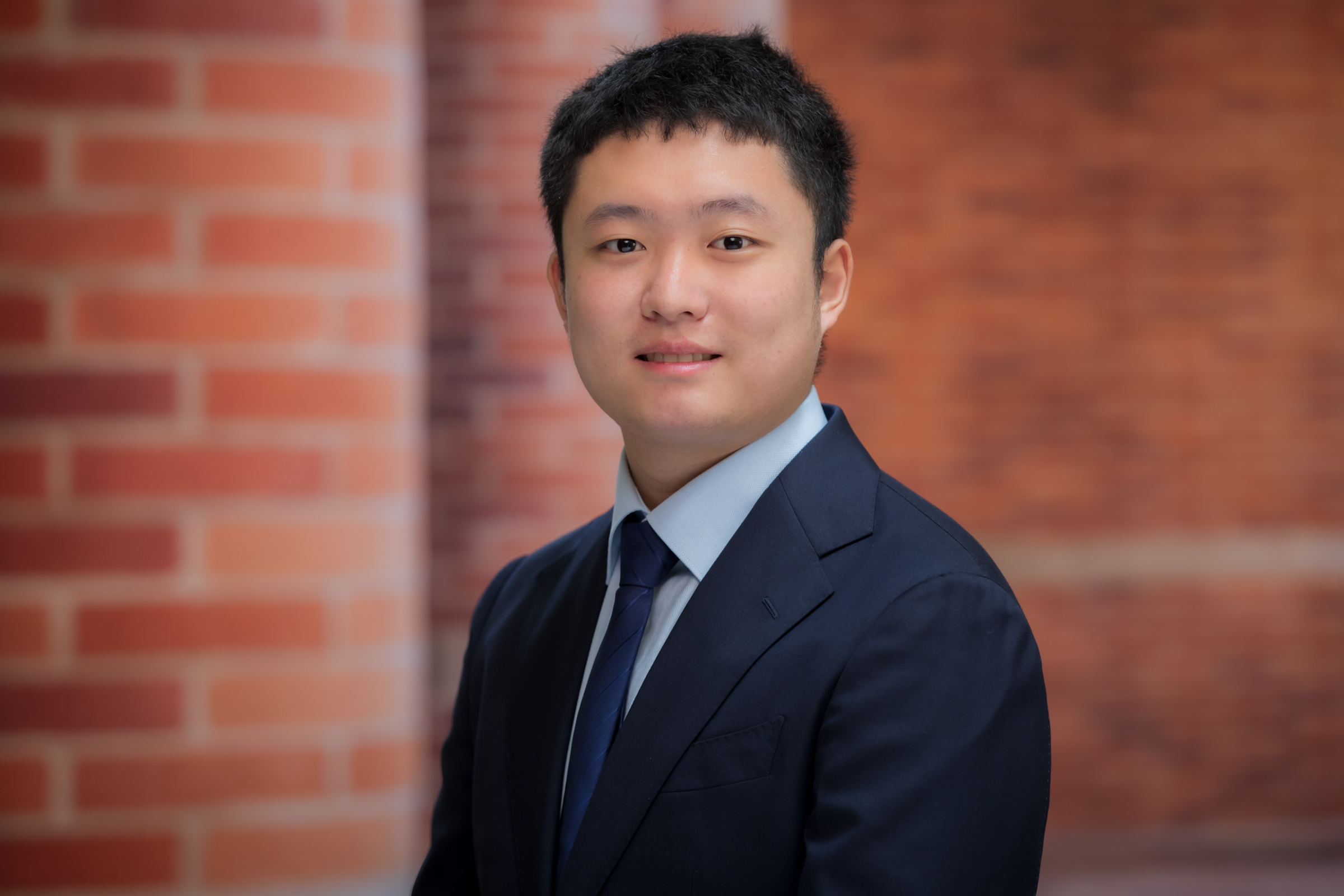
Shaoxiong (Steven) Yuan
UCLA MFE '25 · USC '24 · Orion Alpha Asset Management


B.S. in Computer Science and Business Administration University of Southern California — Class of 2024
About
I’m a quantitative researcher and co-founder of Orion Alpha Asset Management, where I serve as Fund X Managing Partner. My work sits at the intersection of fundamental equity research, derivatives modelling, and machine learning-driven portfolio construction. Fund X has returned 26% over 8 months with a 3.43 Sharpe ratio and 4.6% maximum drawdown.
I hold a Master of Financial Engineering from UCLA Anderson and dual degrees in Applied and Computational Mathematics (AMCM) and Computer Science & Business Administration (CSBA) from USC. My professional background spans capital markets and M&A in Beijing, Shanghai, and New York, including roles at China Reform Securities, Yongxing Securities, and M+A Squared.
Outside of markets, I write film reviews for movies worth thinking about beyond the credits, and occasionally build tools that sit at the edge of finance and software.
Orion Alpha Asset Management

Where Fundamental Conviction Meets Quantitative Discipline.
I am a co-founder and Fund X Managing Partner of Orion Alpha Asset Management — a quantamental investment firm fusing deep fundamental business acumen with Bayesian data validation to eliminate narrative bias and capture market mispricing. Fund X achieved a 26% cumulative return over 8 months in 2025, with a 3.43 average Sharpe ratio and 4.6% maximum drawdown.
Morning Notes
Daily equity research notes on market structure, macro, and trade ideas.
| Date | Headline |
|---|---|
| Mar 7, 2026 | Week-in-Review | Stagflation Confirmed — The Worst Week of 2026 Just Reset Every Narrative |
| Mar 6, 2026 | All Eyes on NFP — Marvell Completes the AI Semi Hat-Trick, Brent Breaks $85 |
| Mar 5, 2026 | Selective Rebound, Not Broad Recovery — AVGO & COST Beat, Oil Surges to 13-Month High |
Industry Analysis
Sector-level deep dives covering market structure, competitive dynamics, and thematic trends — coming soon.
Movie Reviews
I write occasional film reviews when a movie is worth thinking about beyond the credits, more analytical than plot summary.
| Film | Director | Rating |
|---|---|---|
| GOAT | Chris Miller | ★★★½ |
| How to Make a Killing | John Patton Ford | ★★★ |
| The Bride | Maggie Gyllenhaal | ★★½ |
University Course Materials — UCLA
The UCLA Anderson Master of Financial Engineering (MFE) is a STEM-designated, full-time program combining rigorous quantitative finance, machine learning, and asset management. The curriculum spans financial engineering, derivatives pricing, risk management, and data-driven investing. Full details available at the curriculum page. Course materials from my cohort are shared below.
MFE 412 — Trading, Market Frictions and FinTech Prof. J. Zhang
Final Project: Golden Cross & Death Cross EMA Trading Strategy
A group project implementing a momentum-based trading strategy using 8-period and 25-period Exponential Moving Averages (EMAs) on the S&P 500 Energy Sector. The strategy uses Golden Cross signals (8EMA crossing above 25EMA) to trigger buys and Death Cross signals to trigger sells, achieving a 17% annual return vs. 10% buy-and-hold, with a Sharpe Ratio of 0.68 vs. 0.37 for the benchmark.
| Files | Links |
|---|---|
| Course Syllabus | Course Syllabus |
| Presentation | Presentation PDF |
| Jupyter Notebook | Code Notebook |
MFE 413 — Financial Data Analytics and Machine Learning Prof. L. Lochstoer
Final Project: Stock Return Predictability with XGBoost and Random Forest
A group project examining whether combining momentum and fundamental factors can produce a strategy that captures momentum gains while remaining effective long-term. Using CRSP/Compustat data (2012–2024), the study trains XGBoost and Random Forest models to forecast next-month stock returns, evaluated against a Fama-French 3-Factor benchmark via decile portfolios and a Winner-Minus-Loser (WML) long-short portfolio. XGBoost achieved a 26.11% WML return and Sharpe of 0.96 in the test period (2022–2024).
| Files | Links |
|---|---|
| Course Syllabus | Course Syllabus |
| Paper | Research Paper |
| Jupyter Notebook | Code Notebook |
MFE 431 — Advanced Financial Data Analytics and Applications of AI Prof. L. Lochstoer
Final Project: Adaptive Q&A Assistant Using LLM and Neural SSM
A group project (with Taosheng Yin, Shiwen Zou, and Yechao Chen) building a context-aware chatbot that dynamically switches between Explainer, Tutor, and Concise response modes. Traditional stateless chatbots fail when user intent is implicit or evolves across turns — the system addresses this by coupling a Neural State-Space Model (SSM) that maintains a latent conversation state hₜ with a DistilBERT-based regime classifier and explicit intent overrides. The SSM update rule hₜ = fθ(hₜ₋₁, xₜ, zₜ) enables the controller to learn smooth dialog phase transitions. Evaluated on a synthetic multi-turn dataset, the SSM regime model achieved 96.50% test accuracy versus 56.37% for the text-only baseline, with markedly improved stability across conversation turns.
| Files | Links |
|---|---|
| Course Syllabus | Course Syllabus |
| Presentation | Presentation PDF |
| Python Code | Source Code |
MFE 431 — Statistical Arbitrage Prof. M. Chernov
Final Project: Statistical Arbitrage Pair Trading Using Cointegration, Mean Reversion, and Bayesian Optimization
A group project (with Hiu Chun Chan, Saurabh Kulkarni, and Weiyi Wang) implementing a complete end-to-end stat-arb pipeline on S&P 500 equities. The universe is constructed from constituents that remain in the index continuously over 2016–2020, narrowed to the top 50 by market cap, generating 1,225 candidate pairs. Each pair is screened via Engle-Granger cointegration test, ADF stationarity test, and correlation filter. Spread dynamics are modeled using an Ornstein-Uhlenbeck process (dXₜ = κ(μ − Xₜ)dt + σdWₜ), with the half-life t½ = ln2/κ used to discipline maximum holding periods. The Backtrader-based engine trades on z-score entry/exit signals with dollar-neutral sizing and stop-losses, while Bayesian optimization (via skopt) tunes lookback window, entry threshold, stop-loss factor, and holding-time factor to maximize the Sharpe ratio in-sample (2016–2020). Out-of-sample evaluation (2021–2025) on the primary COST–NEE pair yields a Sharpe of 1.69, 6.28% total return, and 64.9% win rate; the best alternative pair ACN–TXN achieves a 16.5% return, Sharpe of 1.66, 90% win rate, and only 8% max drawdown.
| Files | Links |
|---|---|
| Course Syllabus | Course Syllabus |
| Paper | Research Paper |
| Presentation | Presentation PDF |
| Jupyter Notebook | Code Notebook |
MFE 431 — Quantitative Asset Management Prof. B. Herskovic
Final Project: Regime-Based Factor Investing Strategy
A group project developing a novel regime-aware long-short factor investing strategy using CRSP data (1990–2023). Market regimes are identified along two dimensions, macroeconomic regime (Bull/Bear/Sideways via term spread between the 10-year Treasury and 3-month T-Bill) and market concentration regime (Narrow/Normal/Broad via Gini coefficient and HHI), forming a 3×3 matrix of nine distinct regimes. For each regime, an optimal combination of six factor signals (momentum, growth, quality, volatility, value, profitability) is selected, and stocks are ranked by composite Z-score into top/bottom quintile long-short portfolios rebalanced monthly. The strategy generates statistically significant CAPM and FF3 alpha, outperforms the market across all major bear market episodes (151.51% during the GFC), and achieves a maximum drawdown of −45.32% vs. the market’s −50.31%.
| Files | Links |
|---|---|
| Course Syllabus | Course Syllabus |
| Paper | Research Paper |
| Presentation | Presentation PDF |
| Jupyter Notebook | Code Notebook |
University Course Materials — USC
The B.A. in Applied and Computational Mathematics (AMCM) at USC Dornsife is designed for students interested in the mathematical foundations underlying real-world computation, data analysis, and modelling. The curriculum blends rigorous pure mathematics, probability, statistics, linear algebra, analysis, with applied coursework in numerical methods and scientific computing, preparing graduates for quantitative roles in finance, technology, and research.
For Math:
MATH 408 — Mathematical Statistics Prof. J. Bartroff
Course Textbook: Mathematical Statistics and Data Analysis by John A. Rice
Midterm Exam 1
| Files | Links |
|---|---|
| Practice Midterm 1 | Practice Midterm |
| Practice Midterm 1 Solutions | Practice Midterm Solutions |
Midterm Exam 2
| Files | Links |
|---|---|
| Practice Midterm 2 | Practice Midterm |
| Practice Midterm 2 Solutions | Practice Midterm Solutions |
Final
| Files | Links |
|---|---|
| Practice Final | Practice Final |
| Practice Final Solutions | Practice Final Solutions |
MATH 407 — Probability Theory Prof. J. Fulman
There are 38 lecture notes, but the final only covers 1 through 19. There are some practice problems after lecture 19.
Course Textbook: A First Course in Probability (9th edition)
MATH 430 — Number Theory Prof. P. Tokorcheck
Professor Paul Tokorcheck taught this class in a very good fashion. Although “Number Theory” sounds intimidating, it is not. The course content, though abstract, was greatly demonstrated and proved by the instructor. He was also kind enough to write a recommendation letter for the Continuing Students Scholarship.
Course Textbook: Elementary Number Theory by David M. Burton
Additional Useful Reference: Book of Proof
Note: This class has no official lecture notes, but one good way to refer to the content is through the textbook.
MATH 225 — Linear Algebra and Differential Equations Prof. S. Kamienny
Course Textbook: Differential Equations and Linear Algebra by Stephen W. Goode
MATH 226 — Calculus III (Multivariable Calculus) Prof. N. Bottman
Course Textbook: Essential Calculus by James Stewart
| Useful Resources: Symbolab | Wolfram|Alpha | Mathematica Free Download for USC |
Lecture Notes
| Lecture Notes by Months | Links |
|---|---|
| August Lectures | August |
| September Lectures | September |
| October Lectures | October |
| November Lectures | November |
Midterm Exam 1
| Files | Links |
|---|---|
| Practice Midterm 1 | Practice Midterm |
| Practice Midterm 1 Solutions | Practice Midterm Solutions |
| Midterm 1 | Midterm |
| Midterm 1 Solutions | Midterm Solutions |
Midterm Exam 2
| Files | Links |
|---|---|
| Practice Midterm 2 | Practice Midterm |
| Practice Midterm 2 Solutions | Practice Midterm Solutions |
| Midterm 2 | Midterm |
| Midterm 2 Solutions | Midterm Solutions |
The B.S. in Computer Science and Business Administration (CSBA) is a joint degree offered by the USC Viterbi School of Engineering and the USC Marshall School of Business. It combines a full CS core — algorithms, data structures, software development, AI — with a comprehensive business foundation in accounting, finance, and management, producing graduates equally fluent in technical implementation and business strategy.
For CS:
CSCI 360 — Introduction to Artificial Intelligence Prof. B. Dilkina
Course Textbook: Artificial Intelligence: A Modern Approach by Stuart Russell and Peter Norvig (4th edition)
Projects
| Files | Links | Solutions |
|---|---|---|
| Project 1 | PA1 | Solution |
| Project 2 | PA2 | Solution |
| Project 3 | PA3 | Solution |
| Project 4 | PA4 | Solution |
Homework
| Files | Links | Solutions |
|---|---|---|
| Homework 1 | HW1 | Solution |
| Homework 2 | HW2 | Solution |
CSCI 201 — Principles of Software Development Prof. V. Adamchik
Course Textbook: Introduction to Java Programming and Data Structures by Y. Daniel Liang (12th edition)
Programming Assignments
| Files | Links |
|---|---|
| Programming Assignment 1 | PA1 |
| Programming Assignment 2 | PA2 |
| Programming Assignment 3 | PA3 |
| Programming Assignment 4 | PA4 |
My solution to the first two programming assignments can be found here.
CSCI 270 — Introduction to Algorithms Prof. S. Dughmi
Please refer to the course website for more information including course syllabus and assignments!
Course Textbook: Algorithm Design by Jon Kleinberg and Eva Tardos
A Useful Course on Coursera: Data Structures and Algorithms Specialization
CSCI 104 — Data Structures and Object Oriented Programming Prof. M. Redekopp
Please refer to the course website for more information!
My solution to the six programming assignments can be found at this GitHub repository.
CSCI 170 — Discrete Methods in Computer Science Prof. S. Batista
Course Textbook: Essential Discrete Mathematics for Computer Science, by Harry Lewis and Rachel Zax
Midterm
| Files | Links |
|---|---|
| Practice Midterm | Practice Midterm |
| Practice Midterm Solutions | Practice Midterm Solutions |
| Midterm | Midterm Exam |
| Midterm Solutions | Midterm Solutions |
ITP 168 — Introduction to Matlab Prof. R. Kim
Course Textbook: Not Available
Midterm
| Files | Links |
|---|---|
| Practice Midterm | Practice Midterm |
| Practice Midterm Solutions | Practice Midterm Solutions |
Final
| Files | Links |
|---|---|
| Practice Final | Practice Final |
| Practice Final Solutions | Practice Final Solutions |