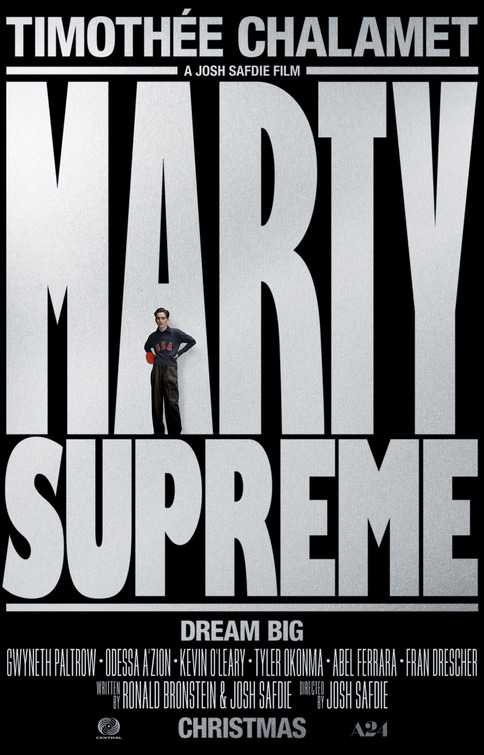
I’ll be upfront: I’m a fairly serious ping pong player, and that coloured my experience of this film more than I expected. The obsessive logic of someone burning their entire life down just to compete in a tournament didn’t ignite something in me the way it clearly does for others. I understand the hunger intellectually. I just couldn’t feel it in my chest. That’s a personal limitation, not the film’s fault, and I want to be clear about that distinction — because Marty Supreme is doing something genuinely interesting, even when it didn’t quite reach me.
The Anatomy of Ambition
What the film captures with real precision is the anatomy of ambition uncoupled from talent ceiling. Marty isn’t delusional. He’s good, arguably great, and he knows it. What he lacks is everything surrounding the game — money, status, legitimacy, the infrastructure that turns skill into opportunity. So he improvises, relentlessly and without much moral hesitation. He steals from a celebrity he befriended. He runs a fake dog scheme on a stranger. He gambles on matches. He deceives, borrows, and manipulates his way toward a plane ticket to Japan, shedding dignity in installments along the way. The film presents this accumulation of schemes with a kind of deadpan matter-of-factness that’s almost funny — you stop being shocked and start anticipating the next angle, which is both the point and, eventually, the problem.
The middle section drags. Once the pattern is established — Marty needs money, Marty finds a way — each new scheme confirms what we already know about him rather than revealing something new. The film would be sharper with thirty minutes carved out of its midsection, because the repetition dulls the edge of what is otherwise a portrait drawn with real specificity.
The Ending
The ending is quietly devastating in a way that sneaks up on you. Marty travels to Japan, doesn’t play in the tournament itself, but finds and beats the one opponent who beat him the year prior — the loss that has been haunting the entire film. He gets his redemption. Nobody in the stands knows who he is. Nobody claps for him specifically. The closure is entirely private, witnessed by no one, meaningful only to himself. And then he goes home, reconciles with his girlfriend, becomes a father to a child that turns out to be his, and resumes something resembling a normal life.
Is that a good ending? I’ve been turning it over. I think the film is making a specific argument: that the sacrifices you make, the moral compromises, the things you do in the dark to chase something — the world doesn’t account for any of it. Nobody tallies your suffering and converts it into recognition. All you can do is give yourself an explanation you can live with, satisfy your own internal ledger, and move forward. Marty beats his demon. Alone. In a gymnasium in Japan where nobody knows his name. That’s it. That’s all he gets, and somehow it’s enough.
There’s something honest about that, even if it’s a little melancholy. The effort was real. The cost was real. The audience was an audience of one.
I get why people love this film. It’s rigorously committed to its own quiet frequency. It just didn’t fully fire me up — and some movies, through no fault of their own, catch you at the wrong angle.