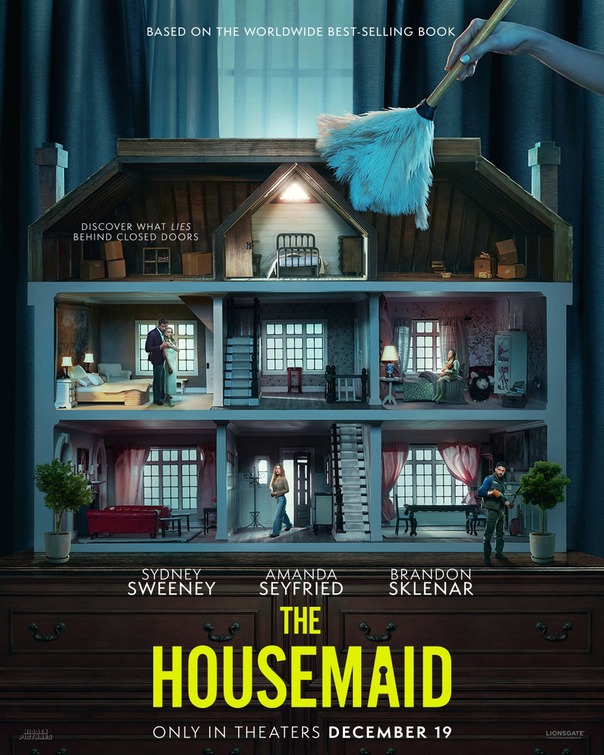
There’s a particular kind of thriller that operates on sustained unease — not jump scares, not gore, but the slow accumulation of wrongness. Paul Feig’s The Housemaid, a 2025 Lionsgate adaptation of Freida McFadden’s bestselling novel, belongs to that lineage, and for most of its runtime, it earns the tension. The closest comparison isn’t another thriller; it’s The Menu. The same architecture of strange, inexplicable behaviour in the opening act, the same sense that everyone in this wealthy enclosure knows something the audience doesn’t, the same class-tinged menace lurking beneath immaculate surfaces. If anything, The Housemaid sticks the landing better. The Menu’s finale tips into self-congratulatory absurdism; this one follows its logic through to something that feels both surprising and earned.
The central misdirection is genuinely effective. Andrew is presented as the charming, benevolent patriarch, and it holds. The reveal of his sadism lands with real force because the film commits to the illusion rather than planting obvious tells. When he finally emerges as the monster, it recontextualises everything that came before, which is exactly what a good twist should do. Less effective is the structural pivot that delivers it: the shift to Nina’s perspective arrives too abruptly, more like a gear slipping than a deliberate narrative turn. A better-calibrated film would have eased us into that reorientation rather than dropping it as a cold reveal.
The Ambiguity at the Centre
Nina herself is the film’s most compelling question. Amanda Seyfried performs instability with an exactness that makes you wonder how much is performance. Is she a survivor shaped by early loss, a psyche genuinely altered by institutionalisation, or something more knowingly predatory — a person who found the role that fits her? The ambiguity is the point, and Seyfried leans into it without blinking. Her strange behaviour in the early scenes, which might initially read as affectation, clicks into devastating coherence once you understand her endgame. It is, as critics noted on the film’s release, a force-of-nature performance that anchors an otherwise uneven ship.
The Ending
The ending is its own small triumph. Two threads tie off with quiet elegance: the police officer, whose own sister fell victim to Andrew’s particular brand of cruelty, makes a choice that is never explicitly explained but needs no explanation. Justice here isn’t institutional — it’s a woman deciding what she saw and what she didn’t. Then Nina’s recommendation of Millie to another household, another wife with a red scar on her arm, signals that this isn’t closure so much as continuation. A chain of women, passing something down. It’s efficient, a little chilling, and more thought-provoking than the film probably gets credit for.
The Casting Problem
The bond between Nina and Millie is the emotional engine. Two women who begin in friction and end in something that resembles solidarity, each recognising in the other someone who has already survived a version of this story. That dynamic works. What works less is Sydney Sweeney in the Millie role. There’s a fundamental credibility gap in casting her as a woman defined by economic precarity and social invisibility. She’s too luminous, too immediately magnetic for the role’s requirements to read naturally. And the intimate scenes feel less like character illumination than contractual obligation, adding little beyond runtime.
But the film’s cumulative effect is strong enough to absorb its unevenness. It kept me genuinely in the dark about where the threat was actually coming from, which is rarer than it should be. And a thriller that makes you reparse the entire first act the moment you understand the ending has done its job.
Sometimes a knife on the table is just a knife. And sometimes it’s everything.